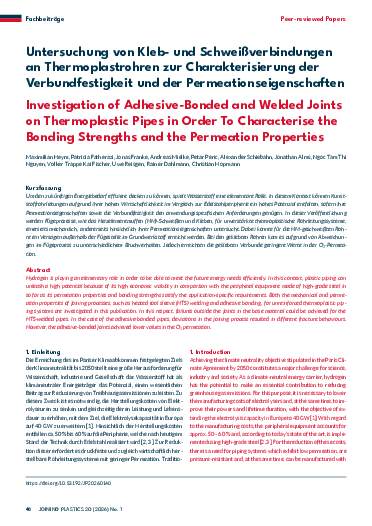
Investigation of Adhesive-Bonded and Welded Joints on Thermoplastic Pipes in Order To Characterise the Bonding Strengths and the Permeation Properties
Peer-reviewed papers
Authors:
M. Sc. Jonathan Alms,
Prof. Dr.-Ing. Volker Trappe,
Prof. Dr.-Ing. Uwe Reisgen,
Prof. Dr.-Ing. Christian Hopmann,
Prof. Dr. rer. nat. Rainer Dahlmann,
Dr. Kai Fischer,
M. Sc. Ngoc Tam Thi Nguyen,
Dr.-Ing. Alexander Schiebahn,
M. Sc. Petar Peric,
M. Sc. Patricia Fatherazi,
M. Sc. Andreas Otto Mielke,
M. Sc. Maximilian Heym
DOI:
https://doi.org/10.53192/JP20260140
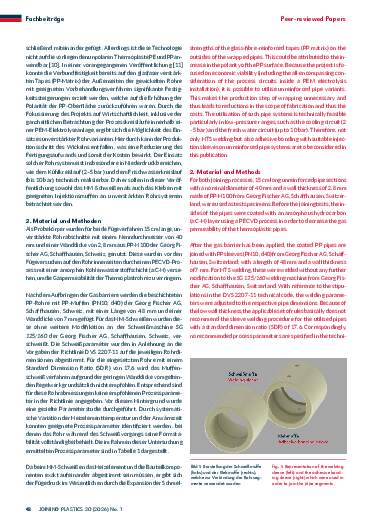
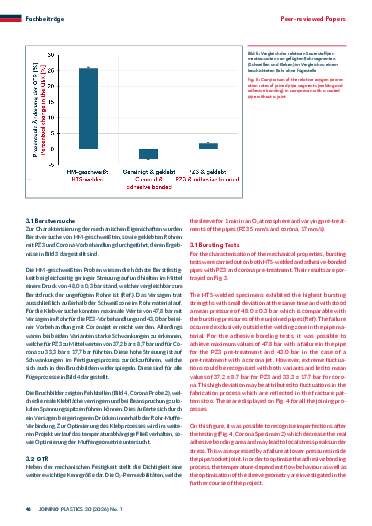
Hydrogen is playing an elementary role in order to be able to meet the future energy needs efficiently. In this context, plastic piping can unleash a high potential because of its high economic viability in comparison with the peripheral equipment made of high-grade steel in so far as its permeation properties and bonding strengths satisfy the application-specific requirements. Both the mechanical and permeation properties of joining processes, such as heated tool sleeve (HTS) welding and adhesive bonding, for unreinforced thermoplastic piping systems are investigated in this publication. In this respect, failures outside the joints in the base material could be achieved for the HTS-welded pipes. In the case of the adhesive-bonded pipes, deviations in the joining process resulted in different fracture behaviours. However, the adhesive-bonded joints achieved lower values in the O2 permeation.